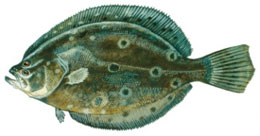
Summer flounder or fluke ( Paralichthys dentatus )
live in estuarine and coastal waters from Nova Scotia to Southern
Florida, with greatest abundance between Cape Cod, Massachusetts and
Cape Hatteras, North Carolina. Most summer flounder inhabit Chesapeake
Bay in the summer and move offshore to depths of 120 to 600 feet of
water during the fall and winter. However, some summer flounder winter
over in the Bay. Flounder are more common the deep channels of the
lower Bay than in the upper Bay, extending as far north as the
Gunpowder River.
Like other
flounders, this species is a bottom-dwelling predator, relying on its
flattened shape and ability to change color and pattern on the upper
(eyed) side of its body. A predator with quick movements and sharp
teeth, the flounder is able to capture the small fishes, squid, sea
worms, shrimp and other crustaceans that comprise the bulk of its diet.
Summer flounder can live to 20 years of age with females living longer
and growing larger than males (up to 95 cm TL (3ft)).
Life Cycle
- Summer flounder spawn during their offshore migration, from late summer to midwinter.
- Larvae
and post-larvae drift and migrate inshore, aided by prevailing water
currents, and enter the Bay from October through May.
- Larval flounder have body symmetry and eyes on both sides of their heads.
- Upon
reaching the estuaries, larval flounder undergo a metamorphosis to the
post-larval stage. During metamorphosis, the right eye of the larval
flounder gradually migrates to the left side of the head–the feature
distinguishing summer flounder from winter flounder, whose eyes are on
the right side–and the body takes on the flattened appearance that it
retains as an adult fish.
- Once the
metamorphosis is complete, the post-larval flounder assumes the adults'
bottom-dwelling lifestyle. Juvenile summer flounder often live among eelgrass beds in the Chesapeake Bay.
The Fishery
Summer
flounder are major recreational and commercial species north of Cape
Hatteras. Anglers catch summer flounder from the shore, piers and boats
with hook and line. The recreational catch far exceeds the commercial
catch in the Bay and near-shore coastal waters. The lower Bay and
seaside inlets produce the bulk of the recreational landings. Between
1979 and 1985, the combined recreational harvest in Maryland and
Virginia averaged 5.5 million pounds per year. Ninety percent were
taken from Virginia waters.
- Commercial landings in Virginia have historically been greater than those in Maryland.
- Between
1981 and 1986, Virginia averaged 5.7 million pounds per year and
Maryland averaged 583,000 pounds. However, more than 90 percent of the
landings recorded for both states has come from outside state waters.
- The great bulk of the catch is produced by the winter trawl fishery that operates in mid-continental shelf waters.
- In
the Bay, summer flounder are commercially caught by haul seines, pound
nets and gill nets, but the species does not form a significant
commercial fishery. In 1990 only 48,000 pounds of summer flounder were
taken in Virginia Bay and ocean waters.
- Since
the mid-1980s commercial and recreational catches have declined
precipitously because of over-fishing and year-class failure. The
Chesapeake Bay record for summer flounder is a fish weighing 15 pounds,
which was taken in Maryland waters.
|